Sunday, 28 January 2018

Homework on Minecraft

1. According to the writer, why might autistic children such as his son, be attracted to Minecraft?

Through Minecraft, autistic children could learn easy and basic skills, that could expand their wider knowledge.

2. Which feature are included in the education version of Minecraft and how useful do you think they might be as an educational tool?

Education version of Minecraft allows teachers to set up classroom servers, where students can build scale models of their own towns, this means they can learn about geography, agriculture, architecture and physics. 

3. Why does Bergensten suggest, have copycat versions of Minecraft been less successful?

The copycat versions have been looking for ways to expand on what the game offers, and some have fared well, but nothing was close to Mojang's vision. The copycat versions tended to have added a lot of visual information to the textures, which is what makes it less successful as Minecraft is more blocky and has a low resolution. 

4. What is meant by the 'modding' community? 

Modding means users can add different types of designs into their game, such as texture maps, items, creatures and even new stories and adventures. They can easily access these mods online and put the files into Minecraft. 

5. How important is the "sense of ownership" cited by Bergensten, for the audience of Minecraft? 

Even though Bergensten heard about the 'sense of ownership' the players have, it seems that he never really minded it because that 'sense of ownership' helped the players in different types of ways, they made up their own rules, own structures and how to interact with others. It even helped an autistic boy as he had a plan of his new school on Minecraft, and later when he actually started to attend the school, he knew exactly where he was going. So, this 'sense of ownership' was beneficial to the audience of Minecraft. 

6. How has Minecraft extended its brand beyond gaming and into other products? 

Minecraft extended its brand through other items not just through games, for example, they even have a huge merchandise, where they sell a lot of Minecraft printed products; 


Monday, 22 January 2018

Gaming

There are many gaming genres, and most of them are similar to movie genres.
  • Action adventure games
  • Shooter games
  • RPG
  • MMO
  • Sandbox rpg - Minecraft; A world that involve lots of free-roaming and freedom.
  • Simulation: The Sims games.
  • Strategy - World of Warcraft
  • Sports - Fifa
Case study of Tera:
 
    • MMO - massively multiplayer online role-playing game


  • Tera is aimed at a demographic audience of 16+ and can be played by both genders. The audience can vary from different countries, doesn't really matter, the audience are mostly from the US and the UK. Social classes doesn't really matter either, because the game doesn't specify for which type of people can play it, it can be played by working-class or upper-class.


  • The game appeals to the audience because of it's different structures, for example, the graphics in the game is quite attractive and of high quality, which would therefore attract the audience and would want to make them play the game. Further, the character customization, again, is quite good, but it'd only attract certain type of people because the character customization doesn't have much choice in what the player can choose their character to look like e.g hair, so it'd only attract the type of people who aren't too fussy as to how their character would look like. The questing in the game is also quite good and pretty straight forward, making it easy for the audience to interact with the game.


  • The game can be consumed through PC, you can also get it through Steam, which is a programme that allows people to buy games from. However, if you are a dedicated player, then you may spend your money on it e.g when you want to buy your character armour and weapons. Related image

Friday, 19 January 2018

The Film Industry: Hollywood

Hollywood is a mentonym = a word, name, or expression used as a substitute for something else with which it is closely associated. For example, Washington is a metonym for the US government.

Hollywood:


  • Plastic Surgery
  • Movies
  • Rich people/actors
  • Art
  • Stars
  • Red carpet
  • Theatre
  • Flashing lights
  • costumes


How was hollywood invented?

Film was invented in France, but the Hollywood studios started to become all powerful by the 1920s. The studio built up their power by following what is called "Fordist" economic model and establishing a system of vertical integration.

vertical integrationthe combination in one firm of two or more stages of production normally operated by separate firms. Production, distribution and consumption.
Image result for henry ford
"Fordist"the use in manufacturing industry of the methods pioneered by Henry Ford, typified by large-scale mechanized mass production. Named after henry ford, a very efficient way of producing goods like cars based on 1. standardising the product
2. assembly line production


20th century fox: For many years, 20th Century Fox claimed to have been founded in 1915, the year Fox Film was founded.
However, in recent years it has claimed the 1935 merger as its founding, even though most film historians agree it was founded in 1915.

antitrust laws - in the late 1940s the US government brought an end to the vertical integration system 
and forced the studios to sell off their cinemas


Hollywood now, The Big Six:

  1. Disney
  2. Universal
  3. Warner Brothers
  4. Fox
  5. Sony
  6. Paramount
Media plurality- is about the information that people consume on a daily basis, which informs their views and perspective on the world. 'Media plurality' means having a diversity of viewpoints available and consumed across the media.

Disney wants to buy Fox because of Netflix, They are going to start up their own version,
If they own Fox they can put way more content on things because they'll own it.

In contemporary hollywood, individual independent production put together a production-the studios then 'buy into' the film, offering money in exchange for distribution rights and possibly leasing ut facilities (the studio in which to film)

Average budget for a major films $60-100 million,
budget spent on:
  • Cast
  • story rights
  • producer + director fees
  • VFX
  • music rights
Distributors will acquire a film for a fee and gain the rights to sell it (normally on all platforms)*
A % of box office will go back to producers (after they get back all the money they spend)
They will pay for the marketing of the film.
This marketing budget can vary massively. The last Transformers film cost $210m to make and $200m to market. Low budget horror films like The Purge were cheap to make (under $5m) but costly to market (more than $20m)
Marketing of the movie IT: IT left around creepy red balloons in Sydney; Image result for it marketing campaign balloonsImage result for it marketing campaign balloons


Monday, 15 January 2018

Newspapers and Politics (revision material 2)


  • In the UK, “the press” is free, and most journalists believe this is fundamental to a democratic society. This means that newsmakers should seek out and circulate news, information, ideas, comment and opinion and hold those in authority to account. The press provides the platform for a multiplicity of voices to be heard.

  • This means that newspapers are allowed to express opinions, and this includes political views.  After the 2011 phone hacking scandals involving a range of newspapers, a major report was published, by Lord Leveson.  As a result, a new press regulator, IPSO, was set up.  The aim was to ensure the press was more tightly regulated, which might have meant less freedom than under the previous system, where the press regulated itself.


  • Historically, newspapers have had well-established links with political parties.  Sometimes owners give substantial donations to parties they support.  In the lead up to a elections, newspapers have openly supported and criticised parties.  

  • News Corp is a UK newspaper group and it is part of a much bigger global conglomerate.

Left and Right wing: 


You will often hear people talk about ‘left wing’ and ‘right wing’ - but what does it mean? It means what people believe a country should do for its citizens.
In the UK, left wing politics are those traditionally aligned with the Labour party, and right wing are those traditionally aligned with the conservatives.

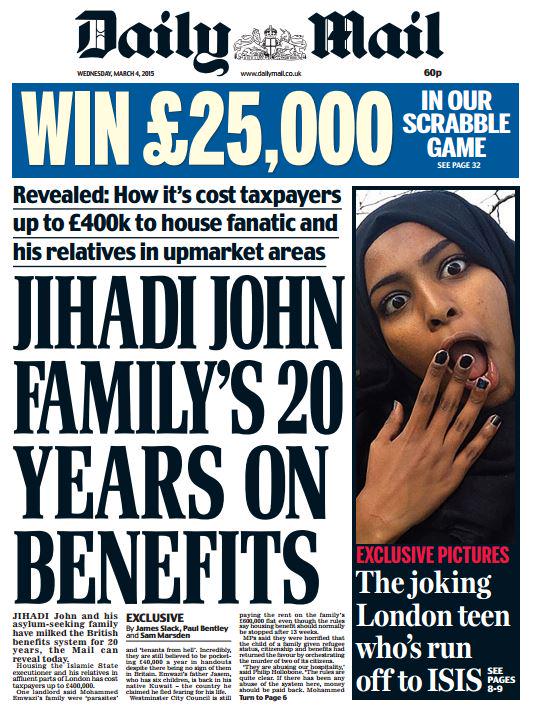
Image result for daily mail immigrationThe Daily Mail is right winged; The right wing is against the idea of benefits because they believe people should be more independent and pay for themselves. Right wing beliefs value tradition, they are about fairness, survival of the fittest, and they believe in economic freedom.
They typically believe that business shouldn’t be regulated, and that we should all look after ourselves.
Right wing people tend to believe they shouldn’t have to pay for someone else’s education or health service.
They believe in freedom to succeed over equality.
Image result for daily mail benefits

Image result for the guardian poverty newspaper
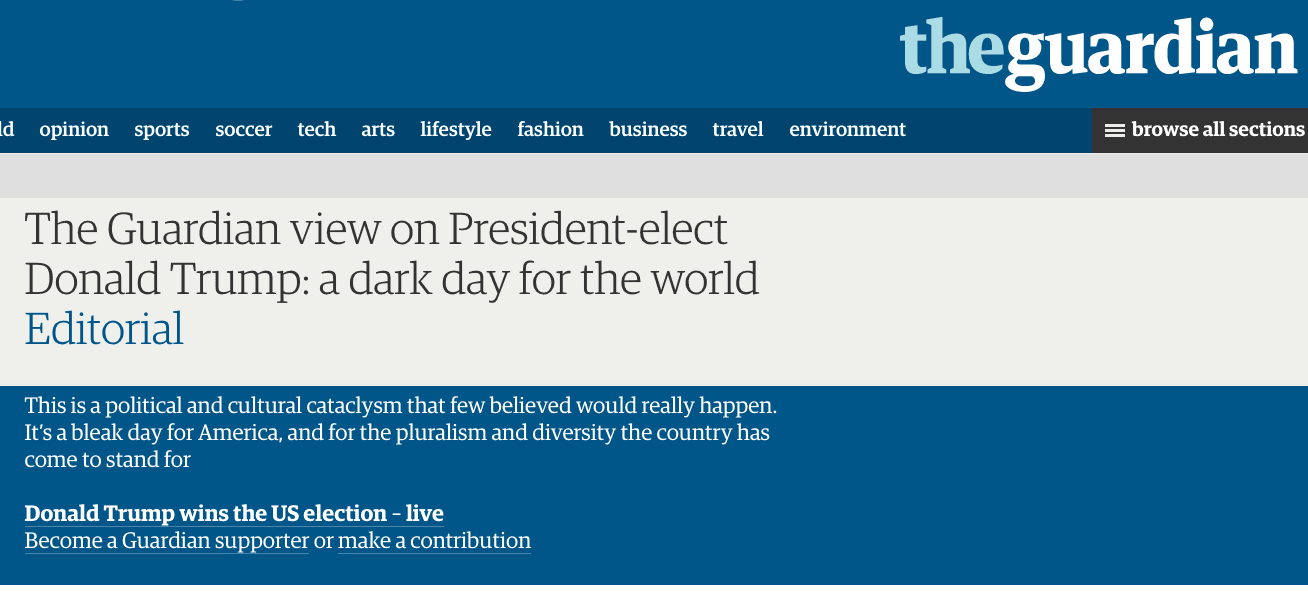
Image result for the guardian left wingThe Guardian is left-wing because left wing beliefs are usually progressive in nature, they look to the future, aim to support those who cannot support themselves, are idealist and believe in equality.
People who are left wing believe in taxation to redistribute opportunity and wealth - things like a national health service, and job seeker’s allowance are fundamentally left wing ideas.
They believe in equality over the freedom to fail.

Monday, 8 January 2018

Comparing The Daily Mail and The Guardian.

  • They are immediate and up to date. When something happens, users can access the news and get regular updates:

The Guardian is up immediate and up to date; 


The Daily mail is also up to date;


  • They offer more immediate interactive opportunities, for example there is access to audio-visual clips and opportunities to blog or email opinions. The Daily Mail which has a high percentage of female readers, has had particular success with its online version of female with its diet of fashion and gossip:


The Guardian:  It shows that the users can interact by watching audio-visual clips such as the one below, and beside the video, we can see that there are options of how the users can reach the Daily Mail, we have the Facebook option, the Twitter option and the option to email. 


The Daily Mail: Also shows that users can interact by watching audio-visual clips and below it also has the sharing options users can take. The Daily Mail also has a side section for female users who can view all the gossip about celebrities;


  • Apps for several newspapers are available for mobile phones and tablets
These apps are very useful to people in their everyday life, having newspaper apps is greatly significant because it means people can view the news on the go, especially when they're travelling to work. There are many newspaper apps, such as:


Thursday, 4 January 2018

The Film Industry

Genres:

  • romance
  • horror
  • thriller
  • action
  • drama
  • sci-fi
  • fantasy
  • historical
  • crime 
  • adventure
  • surreal 
  • comedy
  • fiction
  • documentary
  • international e.g russian movies
  • psychological
  • musical
  • sports

Why genres? We need genres because there are different types of movies that appeal to someone; people have their own preferences. 

Steven Neale: Popular cinema relies on audiences finding pleasure in difference and repetition i.e recognition of familiar elements and the way those elements are linked in an unfamiliar way or the way that unfamiliar elements might be introduced.


From the spec: Genre theory is about what genres are, and about how and why they are created, chang, endure or decline. Neale argues that genre is a process by which generic codes and conventions are shared by producers and audiences through repetition in media products

Codes and conventions

  • Mis-en-scene
  • Props
  • Non-diegetic/diegetic sounds
  • Iconography 
  • Structure
  • Theme
b) Vampire Horror iconography: 
  • Blood
  • Vampires
  • Fangs
  • Dark clothing
  • Suspenseful music
  • Murder
  • Stereotypically a stake and coffin 
  • for make up; pale skin, different coloured eyes, stereotypically they'd be red
  • gothic settings; castle, rich, opulent settings
Structure: A mysterious, secretive new guy in school, and all the girls are interested, but he only focuses on one girl and tries to get close to her, eventually the girl would fall in love with him, but once the truth is revealed about him being a vampire, the girl is shocked but despite that, she stays with him 

Theme:

Structures for a Teen movie: 

A rite of passage narrative: moving from once social identity to another

Could manifest in: change from geek to princess, loser to winner, losing virginity

Also power structures within the high school setting.

General themes: the need to belong to a group and the importance of popularity

Genre stages:

1st stage - primitive, the formative stage in which the genres characteristics are first established

2nd stage - the classical, the genre at its peak, with generic qualities refined

3rd stage - the revisionist, which scrutinizes and reevaluates, often in a critical way, the conventions that typify the genre

4th stage - the parodic, in which the genre is satirized in a consciously self-reflective, tongue-in cheek manner

Andrew Tudor: "A genre defines a moral and social world"

The rise of the teenager: The great depression of 1930s forced young people into  high schools because there were no jobs, but in the 50's, it was a time of prosperity, which meant that teenagers no longer had to work. Teens were loyal to the cinema in the 1950s due to the rise of TV, it was quite cheap and common.

In more recent years, filmmakers have sought to redefine teen movies; critical movies, often made by outsider voices, were made by within the genre


Pastiche - a 'lovely', respectful homage to previous conventions


Tarantino's films are often viewed as pastiches of multiple genres


Parody - a humorous subversion of genre expectations. Audiences enjoy seeing conventions subverted


The Spoof - More a series of 'gags' than a fully functioning narrative, dependant on specific genre knowledge. Generally popular with teens and can be highly profitable due to low production costs.


Thursday, 7 December 2017

The Daily Mail focuses on politics, the Royal family, the weather, celebrities,

The Guardian - Politics, sports, health

Curated content - There is too much happening in the world for us to keep up with. We can only realistically process a small amount of news. But who should decide?
1. Supply-led content: 'gatekeepers' are people who decide which news are important, in news this would be the editors and the journalists.
2. Demand-led, no 'gatekeepers', we decide what is important, we follow the people that interest us and ignore the rest.

Clay-Shirkey - Cognitive Surplus, focuses on describing the free time that individuals have to engage with collaborative activities within new media.
In my own words, the free time that people have on their hands to engage in collaborative activities, especially the internet

Twitter- launched in 2006, twitter is a web 2.0 social media with over 300 million active users. 

What's the point of Twitter? People get to check in on famous celebrities, etc Twitter is also used by journalists, and this is because from twitter, they can easily get gossip and drama about celebrities.  However, there are many fake accounts, which means fake stories.

  • Vox pops - The average person's opinion 
  • Marketing and distribution platform 
  • Source of tips 


So social media can assist in the production, marketing and exchange of news.


They're both popular because they post news that are about politics, celebrities, the Monarchy and overall, human interest. They're also quite similar, as they post nearly the same things, except the Guardian posts more sports.

Wednesday, 29 November 2017

Fake news and how to create some.

PLAN:
1) an introduction of us saying what we're gonna do, and we're gonna list pros and cons

2) Record screen using fraps, going through fake news

3)separately record a voice over using phone and then transfer the audio file into computer

4)then over the screen recording, put the voice over audio over it (make sure it is in time though)


Alina: Hey guys, so today we're going to be talking about fake news, which is false information under the guise of news reporting. 

Honey n Kev: The pros of it is that you get a lot of money from doing fake news, it can be considered as entertainment - making up stories to entertain the audience, like a hobby.

Neila: However, in my opinion, I think that fake news is bad and has a negative impact, for example; it can literally spread false information all around the social media and can cause misunderstandings between the people who are involved. 


In the screen recording: http://clonezone.link/editclone; show how to clone:

"so a lot of people love to create fake news because it could be considered as a hobby, and we're gonna show you how to create fake news. So what you want to do is go to clonezone.link and type in any website you prefer, so for example, for fake news, we're going to use mailonline.com and choose a random article, and as you can see, the titles are highlighted and you can literally change it if you wanted to." <-- Put this over the screen recording


Final video: Fake news and how to create it

Saturday, 25 November 2017

The cases of Madeleine McCann and Shannon Matthews.


Image result for who is madeleine mccannMadeleine Beth McCann (born 12 May 2003) disappeared on the evening of 3 May 2007 from her bed in a holiday apartment in Praia da Luz, a resort in the Algarve region of Portugal, sparking what one newspaper called "the most heavily reported missing-person case in modern history". Her whereabouts remain unknown. The theory seems to have been that the two doctors killed their daughter by accident, possibly by giving her too much sedative in the hope that she would sleep while they went out to dine with friends at a tapas restaurant 50 yards away.


 Shannon was nine years old when she went missing for 24 days in 2008Shannon was a nine year old girl who went missing for 24 days in 2008, it was later discovered that 

On December 4 2008, mum-of-seven Karen and Donovan were found guilty of kidnapping, false imprisonment and perverting the course of justice.Both were sentenced at  Leeds Crown Court to eight years behind bars.


It has been claimed Karen wrote "dirty letters" to pen pals from prison.


And her friend Julie, the woman who organised the search for Shannon, since said she believes Karen was trying to get away from Meehan, was pressured into calling the police and reporting her daughter missing, and was then tied to the lie.


Meehan was jailed for 20 weeks after unrelated child sex abuse material was discovered on his computer.


(1.) Find examples of language used in each of the pieces to describe the parents of both children: "

In the article of Madeleine, it says "The McCanns described how they plan to use some of the £300,000" which suggests that they're quite a wealthy family who have a lot of money, which would mean they'd be able to make the disappearance of their daughter more important. Throughout the article, we see a series of adjectives such as; "traumatised", "terrifying", "tearfully" whilst also being described as "totally protective parents" which portray the horror that the McCann family went through when Madeleine had went missing, and that they're in distraught. Further, in corroboration to the support of them being wealthy, is that the McCanns also had a spokesperson to emphasise the importance of the case; "personal psychologist" and "a source close to the McCann family." However, in Shannon's article, the differences between the two is wide. For example, the article portrays rather a negative view on the parents; "Miss Matthews, who has seven children to five fathers" clearly states that she is a stereotypical mother who is on benefits due to having seven children, it also portrays that she is a mess, as she was having an affair with the main who kidnapped her daughter. Further, we can see that the dysfunction of Shannon's family and mother is showed through a comparison to a "Channel 4 drama series Shameless, shown in the month before the nine year old vanished" which describes how the daughter of a character in the series, fakes a kidnap of the character's youngest son in order to gain money.
Overall, the two families show quite a contrast to each other as they both come from two different social classes. The McCann family is definitely from an upper and wealthy class, whereas the Matthews, came from the middle-working class. Both have stereotypes demonstrated, such as the wealthy family having more support due to a sufficient amount of money, whereas the middle and working class are seen to struggle and be put on benefits.

(2.) The comparison between the two pictures is unique. The colours are also contrasted. For example, for Madeleine, she is looking quite oblivious as if she didn't know the picture was taken, and this could be because she was distracted and was having fun. However, more importantly, in the mis-en-scene, her hair is seen to be neatly brushed, which says something about her character and background; she comes from a wealthy and organised family, and by the choice of colour she is wearing; pink, demonstrates that her parents treat her quite well, and they may want her to adapt to a female stereotype of having to wear pink. But, the pink can also connote that she is located somewhere relaxed, in this case, Algarve, given by the short sleeves, she is somewhere warm, which again, signifies that her family is from a wealthy background, as they have enough money to travel around and go on holidays. In contrast to this, the mis-en-scene in Shannon's picture is quite dull looking as it all contains blue and navy blue. She is seen wearing a school uniform, which is the opposite to Madeleine, she is in more of a relaxed scenery, whereas Shannon is in a school environment. Her hair is also messy, which connotes that she may be a tacky character, and her having to wear a school uniform could signify that she is of a stereotypical, working-class family background. Both shots are portrait, with no significant backgrounds. However, Shannon looks aware of the picture and is even smiling, whereas Madeleine doesn't. It could suggest that maybe Shannon preferred to stay in at school rather than go home.


(3 and 4 in one) News coverage can be hierarchical, for example, in Madeleine's case, the Telegraph intended to make the audience feel sorry for the disappearance of Madeleine, however in my opinion, as a reader, I'm opposed because I don't feel sorry for the family, due to the fact of my belief that parents should never leave their children alone, especially if they are as young as Madeleine. Further, since the McCann family is quite healthy, people who have money, have social power, so they can manipulate attitudes and make the audience feel sorry for them. However, the Telegraph has a different connotation towards the Matthews, because as they are a middle-working class with benefits, they are portrayed as people who struggle with their life and resort to doing any types of things in order to gain money. The Telegraph has clearly intended to make the audience feel hate and negativity towards the mother, and this is due to how she was being described. In my opinion, using the Reception theory, I'm clearly an opposed reader and that's because I think both are very much guilty, especially the Matthews, as she fake kidnapped her daughter in order to get money, and for the McCanns, they should have never left their child alone, especially since they were very young and should have been under supervision.


Friday, 17 November 2017

Journalism

Keywords:


  • Ethics - Morals, but morals are individual, whilst ethics is a shared system of morals, dealing with what is good and bad: 1) Accuracy 2) Independence 3) Impartiality 4) Humanity (being aware of your own consequences, don't be a dick, be nice :-) 5) Accountability 
  • Truth and Accuracy
  • Self Regulation
  • Public Interest

What would some of your ethical considerations be when: 

-Reporting on a 15y/o student who has traveled with ISIS - I'd be respectful since that is what the student has decided to do, but at the same time, it's considered to be a wrong decision since it's dangerous and deadly, and I'd think that the student was brainwashed into joining ISIS, since they don't really stand for anything - not even religion. Cause he's also underage, I'd have to take accountability for him 


Reporting on a mass shooting in America - Don't mention religion, cause some mass shootings have nothing to do with religion, also I wouldn't talk about it too much, cause some readers wouldn't want all the gory-details, because it may be distressing to some,

A ‘self regulatory body’ - the regulate themselves rather than being regulated by the government.

1. Truth and Accuracy

Journalists cannot always guarantee ‘truth’, but getting the facts right is the cardinal principle of journalism. We should always strive for accuracy, give all the relevant facts we have and ensure that they have been checked. When we cannot corroborate information we should say so.

2. Independence

Journalists must be independent voices; we should not act, formally or informally, on behalf of special interests whether political, corporate or cultural. We should declare to our editors – or the audience – any of our political affiliations, financial arrangements or other personal information that might constitute a conflict of interest.

3. Fairness and Impartiality

Most stories have at least two sides. While there is no obligation to present every side in every piece, stories should be balanced and add context. Objectivity is not always possible, and may not always be desirable (in the face for example of brutality or inhumanity), but impartial reporting builds trust and confidence.

4. Humanity

Journalists should do no harm. What we publish or broadcast may be hurtful, but we should be aware of the impact of our words and images on the lives of others.

5. Accountability

A sure sign of professionalism and responsible journalism is the ability to hold ourselves accountable. When we commit errors we must correct them and our expressions of regret must be sincere not cynical. We listen to the concerns of our audience. We may not change what readers write or say but we will always provide remedies when we are unfair.

Newspaper codes and conventions

Newspapers can commonly be defined as either a ‘broadsheet’ newspaper or a ‘tabloid’ newspaper.
They both look quite similar, they have the same conventions.